Buy voip-blog.com ?
We are moving the project
voip-blog.com .
Are you interested in purchasing the domain
voip-blog.com ?
domain@kv-gmbh.de · 0541-91531010
Buy voip-blog.com ?
Why doesn't port forwarding work on TP-Link?
Port forwarding may not work on TP-Link routers due to several reasons. One common reason is that the router's firmware may not be updated to the latest version, which can cause issues with port forwarding. Additionally, incorrect configuration of the port forwarding settings or conflicts with other network settings can also prevent port forwarding from working properly on TP-Link routers. It is important to ensure that the router's settings are properly configured and that any firewall or security software is not blocking the forwarded ports. **
What is the problem with port forwarding on TP-Link?
The problem with port forwarding on TP-Link routers is that it can be complex and confusing for some users. The user interface for setting up port forwarding can be difficult to navigate, and there may be limited documentation or support available to help users troubleshoot any issues they encounter. Additionally, some users may find that the port forwarding settings do not work as expected, leading to frustration and difficulty in accessing their desired services or applications. Overall, the problem with port forwarding on TP-Link routers lies in the user experience and the potential for technical difficulties. **
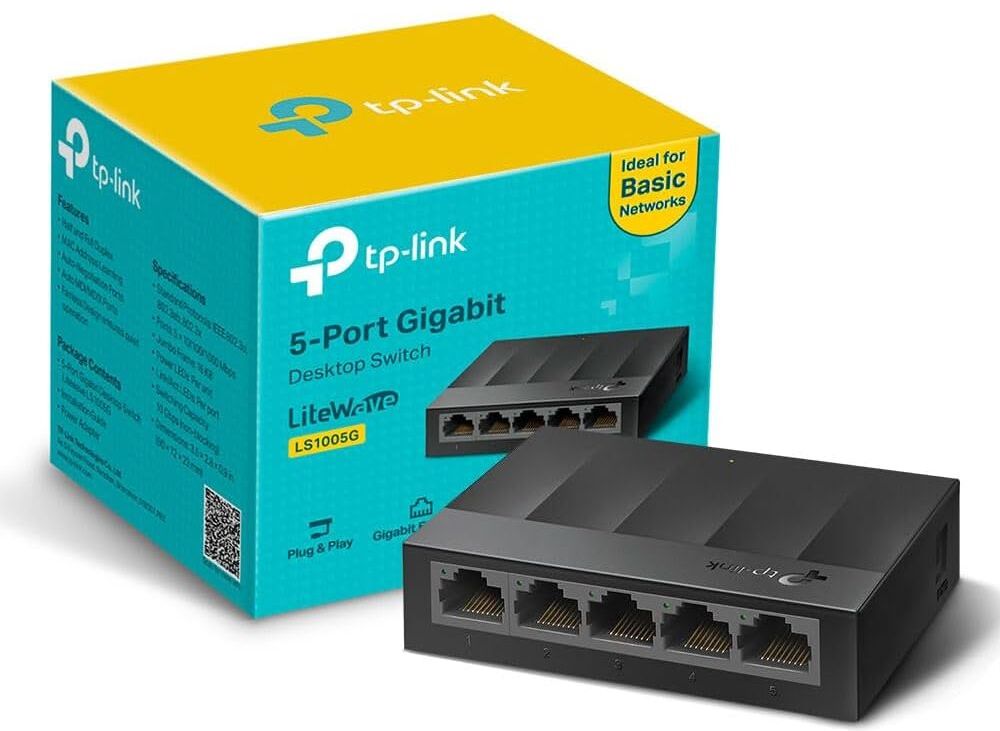

Similar search terms for TP-LINK-LS1005G-5-Port-Gigabit
Top-Angebote
Products related to TP-LINK-LS1005G-5-Port-Gigabit:
-
TP-LINK TL-SX1008 8-Port Gigabit Switch8-port Gigabit Ethernet switch with 160 Gbps bandwidth and 119 Mpps packet transfer capability. Features include flow control, auto-negotiation, auto MDI/MDI-X, and DSCP-based QoS. Compact rack-mountable design with 32,000 MAC address capacity and 2 MB packet buffer.332,99 £*Shipping: 0,00 £Secure redirect to the provider
-
TP-LINK TL-SG105S 5-Port Gigabit Unmanaged Desktop Switch, Metal CaseTP-Link TL-SG105S: a five-port 10/100/1000 Mbps unmanaged plug-and-play desktop switch in a steel case, desktop or wall-mountable, fanless, with shielded ports and power-saving features. No configuration required; it expands one wired uplink to four devices.19,49 £*Shipping: 0,00 £Secure redirect to the provider
-
TP-LINK 8-Port Gigabit Desktop PoE Switch with 4-PortPoE Switches for Your Ultra Convenience8-Port Gigabit Desktop Switch with 4-Port PoEPower over Ethernet4 of the 5 Auto-Negotiation RJ45 ports (Port 1 to Port 4) of the switch support Power over Ethernet (PoE) function. These PoE ports can automatically detect and supply power with those IEEE 802.3af compliant Powered Devices (PDs).Intelligent Power ManagementWhen total power consumption excels 55W, the intelligent power management will cut the lower priority port power off to ensure the high priority port’s power supply and protect the device from power overload operation.Sturdy Metal CasingSturdy, compact metal casing and shielded RJ45 ports, with desktop, to meet your needs in any environment. Besides, fanless design ensures quiet operation.65,49 £*Shipping: 0,00 £Secure redirect to the provider
-
TP-LINK JetStream 8-Port Gigabit Smart Switch with 4-Port PoE+Smarter Switching for Smarter ResultsJetStream 8-Port Gigabit Smart Switch with 4-Port PoE+Multiple Application ScenariosThe TL-SG2008P is fully compatible with PoE devices, such as IP cameras, access points, and IP phones. It also works with non-PoE wired devices to provide gigabit connections, such as PCs, printers, and IPTV.Power over Ethernet for Simplified Network DeploymentFeatures four 802.3af/at compliant PoE+ ports, the switch supports up to 62 W total PoE power budget.* Designed to use a single Ethernet cable for both data and power transmission, it offers flexible deployment for PoE-supported devices such as wireless access points, IP cameras, and IP phones, lowering infrastructure costs for small businesses.Omada SDN—Smarter Cloud Solution for Business NetworkingOmada Software Defined Networking (SDN) platform integrates network devices including access points, switches and gateways, guaranteeing powerful business network with higher efficiency, higher security, and higher reliability.Easy Management with the Omada AppFollow configuration instructions on the free Omada app to get set up in minutes. Omada lets you configure settings, monitor the network status and manage clients, all from the convenience of a smart phone or tablet.99,99 £*Shipping: 0,00 £Secure redirect to the provider


-
How can I set up port forwarding on a TP-Link router?
To set up port forwarding on a TP-Link router, you will need to access the router's web-based management interface. Open a web browser and enter the router's IP address in the address bar. Log in with your username and password. Once logged in, navigate to the "Forwarding" or "Virtual Servers" section in the router's settings. Here, you can add a new port forwarding rule by specifying the port number, protocol, and the local IP address of the device you want to forward the port to. Save the changes and the port forwarding rule will be set up on your TP-Link router. **
-
'Ubiquiti or TP-Link?'
Both Ubiquiti and TP-Link are reputable brands in the networking industry, but they cater to different market segments. Ubiquiti is known for its high-performance, enterprise-grade networking equipment, often used by businesses and professionals. TP-Link, on the other hand, offers a wide range of networking products suitable for home and small business use, with a focus on affordability and ease of use. The choice between the two brands depends on the specific needs and budget of the user. If you require advanced features and reliability, Ubiquiti may be the better choice, while TP-Link is a great option for those looking for cost-effective and user-friendly networking solutions. **
-
Why doesn't the TP-Link WLAN adapter support 5 GHz?
The TP-Link WLAN adapter may not support 5 GHz because it was designed to be a budget-friendly option for users who primarily need to connect to 2.4 GHz networks. Implementing 5 GHz support would likely increase the cost of the adapter, which may not align with the target market for this particular product. Additionally, some older devices or models may not have the hardware capabilities to support 5 GHz frequencies. **
-
What is the LAN port on the TP-Link RE450 AC1750 used for?
The LAN port on the TP-Link RE450 AC1750 is used to connect the extender to a wired device, such as a computer, gaming console, or smart TV. This allows the wired device to access the extended Wi-Fi network and take advantage of the improved coverage and performance provided by the extender. The LAN port essentially acts as a bridge between the wired device and the extended Wi-Fi network, providing a reliable and stable connection. **


How can I set up port forwarding for the TP-Link Spigot 1165?
To set up port forwarding for the TP-Link Spigot 1165, you will need to access the router's web interface. Once logged in, navigate to the port forwarding section, which may be located under the "Advanced" or "Security" settings. From there, you can add a new port forwarding rule by specifying the port number and the IP address of the device you want to forward the port to. Make sure to save the changes and restart the router for the new port forwarding rule to take effect. **
How can I switch the TP-Link extender to 5 GHz?
To switch the TP-Link extender to 5 GHz, you will need to access the extender's web interface. Connect your device to the extender's network and open a web browser. Enter the default IP address of the extender (usually 192.168.0.254) in the address bar and press Enter. Log in with the default username and password (usually admin/admin). Once logged in, navigate to the wireless settings and select the 5 GHz frequency band. Save the changes and the extender will switch to the 5 GHz network. **
Top-Angebote
Products related to TP-LINK-LS1005G-5-Port-Gigabit:
-
TP-LINK LS1005G 5-Port Gigabit Ethernet Switch – Desktop/Wall-Mount Network Hub, Plug & Play, Plastic CaseProduct Overview: The LS1005G 5-Port Gigabit Ethernet Switch is the perfect solution for expanding your home or office network. With five Gigabit Ethernet ports, this network splitter allows you to connect multiple devices for faster and more stable internet connectivity. Its plug-and-play functionality ensures quick and easy setup without the need for any software installation. The compact, durable plastic case allows for both desktop and wall-mount installation, making it a versatile option for any space. Key Features: 5 Gigabit Ethernet Ports : Provides five high-speed Gigabit Ethernet ports for fast and reliable wired connections to your devices. Plug and Play : Easy to use with no setup or installation required, simply plug in and start connecting devices immediately. Versatile Desktop/Wallmount Design : Can be placed on a desk or mounted on a wall for space-saving convenience and flexibility. Durable Plastic Case : Lightweight yet durable, the plastic casing ensures long-lasting use and protection for the internal components. Improved Network Performance : Ideal for enhancing the speed and stability of your home or office network, supporting multiple devices simultaneously. Energy-Efficient : Designed to operate efficiently with low power consumption, helping you save on energy costs. Product Description: The LS1005G 5-Port Desktop/Wallmount Gigabit Ethernet Switch is a reliable and efficient solution for expanding your wired network. With five Gigabit Ethernet ports, it ensures fast data transfer speeds for streaming, gaming, and browsing. Its plug-and-play feature makes installation quick and hassle-free, while the durable plastic case offers long-lasting protection for the device. Whether you're using it on a desktop or mounting it on a wall, the LS1005G provides flexibility and convenience. Enhance your network setup today with this compact yet powerful network splitter, ideal for connecting multiple devices in any home or office environment.9,99 £*Shipping: 0,00 £Secure redirect to the provider
-
TP-LINK LS1005G network switch Unmanaged Gigabit Ethernet (10/100/1000) BlackLet LiteWave Bring You Lighter Network LifeThe TP-Link LiteWave Series Unmanaged Switches provide easy and affordable way to expand your wired network. They are easy to use and reliable. With these plug-and-play switches, you can expand your network connections to multiple devices instantly. With all ports support Auto-MDI/MDIX, there’s no need to worry about the type of cable to use.Go Green with Your EthernetThe LiteWave Series also supports energy-efficient technology, helping you save power and money. Power consumption automatically adjusts according to link status and cable length, allowing you to expand your network while minimizing your carbon footprint. Save the planet and lower your energy bills — it’s a win-win!Gigabit Ports For Faster SpeedsIncrease the speed of your network with the LS1005G 5-port Gigabit desktop switch. Non-blocking, 5× 10/100/1000Mbps ports enable instant transferring of large, bandwidth intensive files without interference.Use Where You Need, However You NeedThe LS1005G is fully compatible with networked devices such as computers, printers, webcams, IPTVs. It has a wide range of application scenarios and is suitable for networking in school dormitories, surveillance, homes, and small businesses.24,99 £*Shipping: 0,00 £Secure redirect to the provider
-
TP-LINK TL-SX1008 8-Port Gigabit Switch8-port Gigabit Ethernet switch with 160 Gbps bandwidth and 119 Mpps packet transfer capability. Features include flow control, auto-negotiation, auto MDI/MDI-X, and DSCP-based QoS. Compact rack-mountable design with 32,000 MAC address capacity and 2 MB packet buffer.332,99 £*Shipping: 0,00 £Secure redirect to the provider
-
TP-LINK TL-SG105S 5-Port Gigabit Unmanaged Desktop Switch, Metal CaseTP-Link TL-SG105S: a five-port 10/100/1000 Mbps unmanaged plug-and-play desktop switch in a steel case, desktop or wall-mountable, fanless, with shielded ports and power-saving features. No configuration required; it expands one wired uplink to four devices.19,49 £*Shipping: 0,00 £Secure redirect to the provider
-
Why doesn't port forwarding work on TP-Link?
Port forwarding may not work on TP-Link routers due to several reasons. One common reason is that the router's firmware may not be updated to the latest version, which can cause issues with port forwarding. Additionally, incorrect configuration of the port forwarding settings or conflicts with other network settings can also prevent port forwarding from working properly on TP-Link routers. It is important to ensure that the router's settings are properly configured and that any firewall or security software is not blocking the forwarded ports. **
-
What is the problem with port forwarding on TP-Link?
The problem with port forwarding on TP-Link routers is that it can be complex and confusing for some users. The user interface for setting up port forwarding can be difficult to navigate, and there may be limited documentation or support available to help users troubleshoot any issues they encounter. Additionally, some users may find that the port forwarding settings do not work as expected, leading to frustration and difficulty in accessing their desired services or applications. Overall, the problem with port forwarding on TP-Link routers lies in the user experience and the potential for technical difficulties. **
-
How can I set up port forwarding on a TP-Link router?
To set up port forwarding on a TP-Link router, you will need to access the router's web-based management interface. Open a web browser and enter the router's IP address in the address bar. Log in with your username and password. Once logged in, navigate to the "Forwarding" or "Virtual Servers" section in the router's settings. Here, you can add a new port forwarding rule by specifying the port number, protocol, and the local IP address of the device you want to forward the port to. Save the changes and the port forwarding rule will be set up on your TP-Link router. **
-
'Ubiquiti or TP-Link?'
Both Ubiquiti and TP-Link are reputable brands in the networking industry, but they cater to different market segments. Ubiquiti is known for its high-performance, enterprise-grade networking equipment, often used by businesses and professionals. TP-Link, on the other hand, offers a wide range of networking products suitable for home and small business use, with a focus on affordability and ease of use. The choice between the two brands depends on the specific needs and budget of the user. If you require advanced features and reliability, Ubiquiti may be the better choice, while TP-Link is a great option for those looking for cost-effective and user-friendly networking solutions. **
Similar search terms for TP-LINK-LS1005G-5-Port-Gigabit
-
TP-LINK 8-Port Gigabit Desktop PoE Switch with 4-PortPoE Switches for Your Ultra Convenience8-Port Gigabit Desktop Switch with 4-Port PoEPower over Ethernet4 of the 5 Auto-Negotiation RJ45 ports (Port 1 to Port 4) of the switch support Power over Ethernet (PoE) function. These PoE ports can automatically detect and supply power with those IEEE 802.3af compliant Powered Devices (PDs).Intelligent Power ManagementWhen total power consumption excels 55W, the intelligent power management will cut the lower priority port power off to ensure the high priority port’s power supply and protect the device from power overload operation.Sturdy Metal CasingSturdy, compact metal casing and shielded RJ45 ports, with desktop, to meet your needs in any environment. Besides, fanless design ensures quiet operation.65,49 £*Shipping: 0,00 £Secure redirect to the provider
-
TP-LINK JetStream 8-Port Gigabit Smart Switch with 4-Port PoE+Smarter Switching for Smarter ResultsJetStream 8-Port Gigabit Smart Switch with 4-Port PoE+Multiple Application ScenariosThe TL-SG2008P is fully compatible with PoE devices, such as IP cameras, access points, and IP phones. It also works with non-PoE wired devices to provide gigabit connections, such as PCs, printers, and IPTV.Power over Ethernet for Simplified Network DeploymentFeatures four 802.3af/at compliant PoE+ ports, the switch supports up to 62 W total PoE power budget.* Designed to use a single Ethernet cable for both data and power transmission, it offers flexible deployment for PoE-supported devices such as wireless access points, IP cameras, and IP phones, lowering infrastructure costs for small businesses.Omada SDN—Smarter Cloud Solution for Business NetworkingOmada Software Defined Networking (SDN) platform integrates network devices including access points, switches and gateways, guaranteeing powerful business network with higher efficiency, higher security, and higher reliability.Easy Management with the Omada AppFollow configuration instructions on the free Omada app to get set up in minutes. Omada lets you configure settings, monitor the network status and manage clients, all from the convenience of a smart phone or tablet.99,99 £*Shipping: 0,00 £Secure redirect to the provider
-
TP-LINK TL-SG1024D 24-Port Gigabit Unmanaged Desktop/Rackmount SwitchThe TP Link TL SG1024D is a 24-port unmanaged Gigabit Ethernet switch designed to expand wired network connectivity for homes, offices and small to medium-sized networks. All 24 ports support speeds of up to 1000Mbps, providing fast and reliable connections for computers, printers, storage devices and other Ethernet equipment. Designed for straightforward installation, the switch features plug and play operation with automatic negotiation and Auto MDI/MDIX. No complicated configuration is required, allowing compatible devices to be connected quickly while the switch automatically detects the appropriate connection speed. The TL SG1024D provides a 48Gbps switching capacity and a packet forwarding rate of 35.7Mpps, helping multiple connected devices communicate efficiently. Its 8K MAC address table and store-and-forward transmission method support dependable network performance. Energy-efficient technology helps reduce power consumption according to network conditions, while the fanless design provides quiet operation. The switch also supports jumbo frames up to 10KB for compatible network applications. With a rack-mountable design and compact 294 x 180 x 44mm dimensions, the TL SG1024D can be installed on a desk or integrated into a suitable network rack. Its grey finish and robust design make it suitable for both business and home networking environments.101,99 £*Shipping: 0,00 £Secure redirect to the provider
-
Why doesn't the TP-Link WLAN adapter support 5 GHz?
The TP-Link WLAN adapter may not support 5 GHz because it was designed to be a budget-friendly option for users who primarily need to connect to 2.4 GHz networks. Implementing 5 GHz support would likely increase the cost of the adapter, which may not align with the target market for this particular product. Additionally, some older devices or models may not have the hardware capabilities to support 5 GHz frequencies. **
-
What is the LAN port on the TP-Link RE450 AC1750 used for?
The LAN port on the TP-Link RE450 AC1750 is used to connect the extender to a wired device, such as a computer, gaming console, or smart TV. This allows the wired device to access the extended Wi-Fi network and take advantage of the improved coverage and performance provided by the extender. The LAN port essentially acts as a bridge between the wired device and the extended Wi-Fi network, providing a reliable and stable connection. **
-
How can I set up port forwarding for the TP-Link Spigot 1165?
To set up port forwarding for the TP-Link Spigot 1165, you will need to access the router's web interface. Once logged in, navigate to the port forwarding section, which may be located under the "Advanced" or "Security" settings. From there, you can add a new port forwarding rule by specifying the port number and the IP address of the device you want to forward the port to. Make sure to save the changes and restart the router for the new port forwarding rule to take effect. **
-
How can I switch the TP-Link extender to 5 GHz?
To switch the TP-Link extender to 5 GHz, you will need to access the extender's web interface. Connect your device to the extender's network and open a web browser. Enter the default IP address of the extender (usually 192.168.0.254) in the address bar and press Enter. Log in with the default username and password (usually admin/admin). Once logged in, navigate to the wireless settings and select the 5 GHz frequency band. Save the changes and the extender will switch to the 5 GHz network. **
* All prices are inclusive of VAT and, if applicable, plus shipping costs. The offer information is based on the details provided by the respective shop and is updated through automated processes. Real-time updates do not occur, so deviations can occur in individual cases. ** Note: Parts of this content were created by AI.